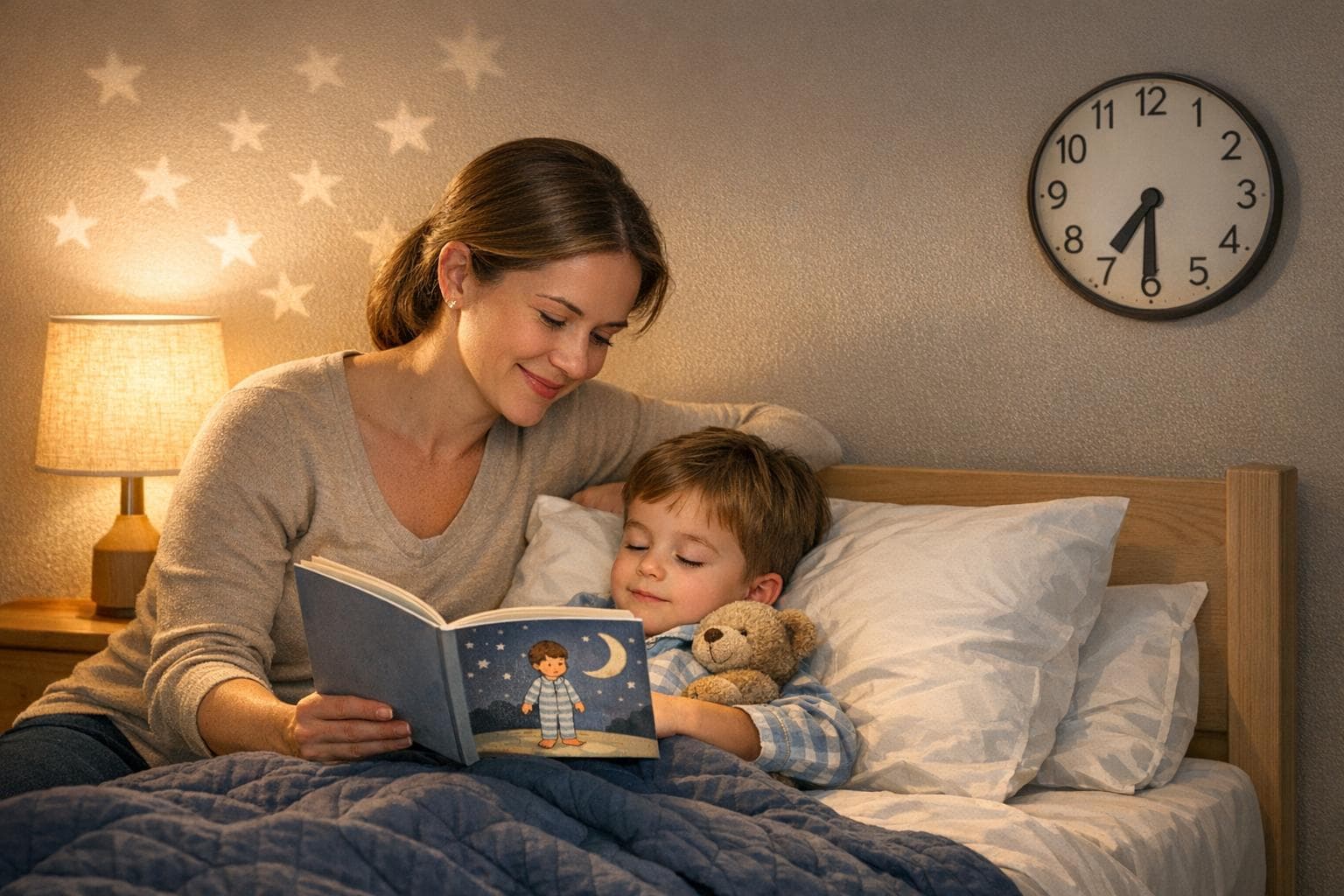
How to Stop Bedtime Battles: A Parent's Guide
If bedtime feels like a nightly struggle, you’re not alone. Many parents deal with resistance, tears, or endless requests for "just one more story." But creating a calm, consistent bedtime routine can make a big difference. Here’s how you can tackle common bedtime challenges and set your child up for better sleep:
- Common Causes: Overstimulation from screens or play, inconsistent schedules, separation anxiety, and nighttime fears often disrupt bedtime.
- Solutions: Establish a regular sleep schedule, include calming wind-down activities (like a bath or reading), and use tools like white noise or a weighted blanket.
- Personalized Storytelling: Stories that include your child’s name and interests can help them relax and fall asleep faster by creating a comforting, engaging atmosphere.
Consistency is key. Stick to the same bedtime routine each night, and watch how small changes can transform your evenings into peaceful, stress-free moments.
Why Is Your Toddler Resisting Bedtime? (And How to Fix It!)
sbb-itb-d6d0693
Common Causes of Bedtime Struggles
Before tackling bedtime battles, it’s essential to pinpoint what’s causing them. Most bedtime resistance stems from identifiable patterns. Recognizing these triggers is the first step toward easing the chaos and bringing calm to your evenings.
Overstimulation Before Bedtime
Activities like intense play or screen time before bed can make it harder for kids to settle down. The blue light from screens suppresses melatonin production, while the stimulating content keeps their brains wired and alert. This hyper-alert state makes relaxation nearly impossible.
Consider this: children under two spend an average of 49 minutes daily on screens, while those aged two to four average 2.5 hours. But it’s not just screens. Bright lights, loud noises, and high-energy activities also raise heart rates and energy levels, making it physically harder for kids to wind down. To help, shut off all electronics at least an hour before bedtime and schedule active play earlier in the day - finishing no later than 60 to 90 minutes before sleep.
Inconsistent Bedtime Schedules
If bedtime changes frequently, your child’s internal clock struggles to adjust. A bedtime that’s too early or too late can disrupt melatonin production or activate stress hormones, leaving your child restless and unable to fall asleep.
Research backs this up: a study of 10,085 families revealed that children with consistent bedtime routines fall asleep faster, sleep longer, and wake less during the night. On average, they gain about an hour of extra sleep each night compared to children without routines. The key is to observe when your child naturally starts showing signs of sleepiness and align their routine with that window.
Separation Anxiety and Fears
For many children, bedtime feels like an extended separation from their parents, which can be genuinely upsetting. Daniel Huerta, Psy.D., explains:
Many young kids do not want to miss out on anything and are still actively curious and looking for stimulation.
This fear of missing out, combined with separation anxiety, can lead to tears, clinging, or repeated requests for comfort. Nighttime fears also play a role: between 10% and 50% of kids aged 3 to 5 experience nightmares, and 3% to 6% have night terrors. When your child asks you to check for monsters or panics when the lights go out, they’re not trying to manipulate you - they’re expressing genuine fears that need your reassurance.
| Common Cause | Signs You’ll Notice |
|---|---|
| Overstimulation | High energy after screen time, trouble calming down, excessive excitement |
| Inconsistent Schedule | Resistance to bedtime, confusion about timing, lying awake alert |
| Separation Anxiety | Crying when you leave, clinging, asking for "just one more" story |
| Nighttime Fears | Asking about monsters, refusing lights off, needing constant reassurance |
Creating a Consistent Bedtime Routine
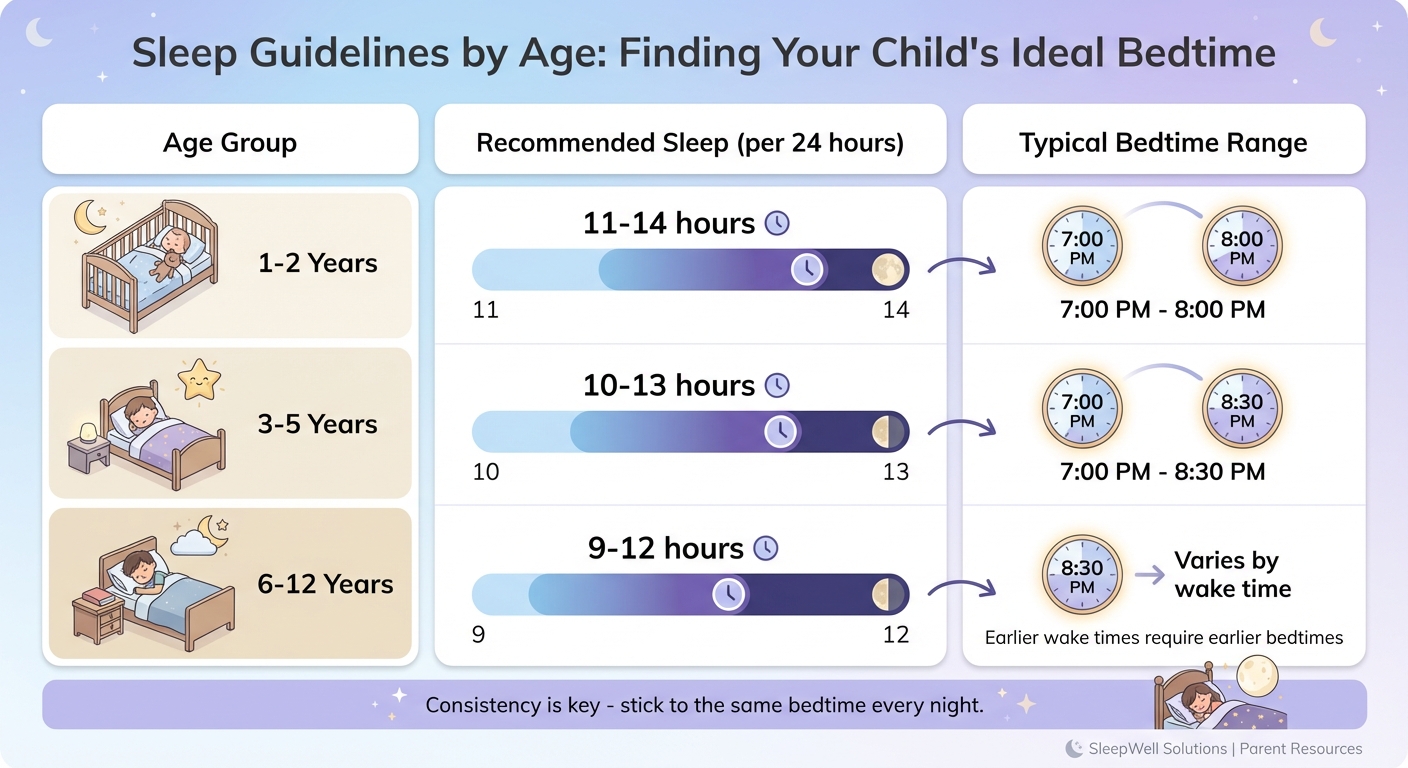
Recommended Sleep Hours and Bedtimes by Child Age Group
Establishing a bedtime routine helps signal your child’s brain that it’s time to sleep. When activities follow the same sequence every night, the body naturally starts preparing for rest. Dr. Chris Winter, President of Charlottesville Neurology and Sleep Medicine, explains:
"Sleep is a skill, not a trait... Developing good sleep habits and routine most certainly insulates for future sleep issues."
The focus isn’t on achieving perfection but on maintaining consistency. Over time, this predictability helps your child transition smoothly into sleep mode.
Set a Regular Sleep Schedule
A steady sleep schedule is the foundation of a calm bedtime environment. Start by calculating bedtime based on your child’s wake-up time. For instance, if your 4-year-old needs to wake up at 7:00 AM and requires 11 hours of sleep, aim for an 8:00 PM bedtime.
Stick to the same bedtime and wake-up time daily. Pediatrician and Sleep Coach Dr. Nilong Vyas emphasizes:
"Consistency signals that it's time for bed, so sleep hormones - melatonin - can activate."
Pay attention to natural sleepy cues like yawning or rubbing eyes, but begin the routine before these signs appear to avoid overtiredness. Kids who are overtired often become more energetic, making it harder for them to settle. If your child takes daytime naps, ensure there’s about a 5-hour gap between the end of the nap and bedtime to build enough "sleep pressure" for nighttime rest.
| Age Group | Recommended Sleep (per 24 hours) | Typical Bedtime Range |
|---|---|---|
| 1–2 Years | 11–14 hours | 7:00 PM – 8:00 PM |
| 3–5 Years | 10–13 hours | 7:00 PM – 8:30 PM |
| 6–12 Years | 9–12 hours | Varies by wake time |
Once the schedule is set, focus on calming activities to help your child wind down.
Add Wind-Down Activities
Start winding down 45–60 minutes before bedtime. This "power-down hour" allows your child’s body to shift from active to calm. Keep screens off during this time, as the blue light from devices can interfere with melatonin production.
The "3 B's" framework - Bathing, Brushing (teeth), and Books - is a simple and effective structure to follow. A warm bath is especially helpful since the drop in body temperature afterward naturally promotes sleepiness. Dim the lights and keep the room cool (68–72°F) to create an environment conducive to rest.
You can also spend a few minutes tidying toys together or laying out clothes for the next day. These small tasks help clear mental clutter and signal the end of the day. Handle last-minute needs like water, bathroom trips, or snacks during this time to avoid bedtime stalling tactics.
Communicate the Routine Clearly
Once you’ve established a routine, clear communication helps reinforce it. A visual routine chart with pictures of each step - like bath time, pajamas, brushing teeth, reading a story, and getting into bed - can be especially helpful for toddlers. Checking off each step gives them a sense of accomplishment and helps them understand what’s coming next.
To minimize power struggles, offer limited choices. For example, ask, "Would you like the dinosaur pajamas or the robot ones?" or "Should we read two books or three?" These small decisions give children a sense of control without disrupting the routine.
End the routine with a consistent closing cue, like a specific phrase - "I love you, good night, see you in the morning" - or a calming ritual such as taking five deep breaths together. Place your child in bed while they’re drowsy but still awake. This encourages them to self-soothe and fall asleep on their own, reducing reliance on your presence.
Using Personalized Storytelling at Bedtime
Incorporating personalized storytelling into a consistent bedtime routine can make those nightly transitions smoother and more enjoyable. Bedtime stories have always been a great way to help kids wind down, but personalized storytelling takes it up a notch. When children hear their own name in a story or recognize characters that reflect their interests, the experience becomes more than just a tale - it creates a calming and engaging atmosphere that gently prepares them for sleep.
How Personalized Stories Capture Attention
Kids naturally focus more when they feel connected to a story. Studies reveal that children engage 40% longer with stories featuring their own name. This is tied to the self-reference effect, where seeing themselves in a narrative makes them feel like the star of their own adventure. This emotional connection is something generic stories just can't match.
Dr. James Peterson, a neuroscientist at Stanford University, explains the science behind it:
"Narrative listening activates the brain's default mode network, which is associated with relaxation and introspection. This is the opposite of the alert, problem-solving mode children are in during the day."
Personalized stories don’t just hold their attention - they also help kids fall asleep quicker. A 2024 study found that children listening to personalized stories fell asleep 8 minutes faster and experienced a 23% drop in stress hormone levels within 15 minutes. This is especially helpful for children who are anxious or overstimulated, as it helps them relax naturally.
These stories can also address specific concerns your child might be facing, such as separation anxiety, fear of the dark, or adjusting to changes like starting a new school. Therapist Evan Shopper highlights the benefit of using storytelling to create "emotional distance", giving kids a safe way to explore and process their feelings without becoming overwhelmed.
Why Kidooki Stands Out: Narration and Illustrations

Kidooki takes personalized storytelling to the next level by combining it with professional narration and soothing watercolor illustrations. A calming narrator can make children feel secure - an important factor in helping them drift off to sleep. Unlike reading a book, listening to narrated stories lets kids close their eyes and imagine the tale in their own way, which is less mentally taxing and encourages drowsiness.
John Fox, Editor and Founder of Bookfox, explains:
"By telling children stories that do not require following along with their eyes, children can fill in the narrative with their own imagery... and the story can conclude as soon as they become drowsy."
Kidooki’s watercolor illustrations add another layer of relaxation. With soft brush strokes and gentle colors, the visuals evoke the dreamy, half-asleep feeling of a cozy bedroom. Unlike bright screens, these illustrations avoid blue light, which can interfere with melatonin production and disrupt sleep cycles.
Every night, Kidooki crafts a new story tailored to your child’s name, age, and interests. You can even save favorite stories in your library and create profiles for multiple children, making it easy to include personalized storytelling in your nightly routine.
Kidooki's Free Trial and Subscription Options
Kidooki offers a free trial so you can explore personalized bedtime stories without any commitment. No credit card is required, and during the trial, you’ll have access to personalized stories, audio narration, illustrations, and the story library.
After the trial, subscribing unlocks the full experience, including nightly new stories, profiles for multiple children, and unlimited access to your story library. This ensures that every child in your family can enjoy their own magical bedtime tales.
Pricing Overview
| Plan Type | Price | Key Features | Limitations |
|---|---|---|---|
| Free Trial | Free | Personalized stories, audio narration, watercolor illustrations, story library | Limited to trial period |
| Subscription | Not specified | Nightly new stories, multiple child profiles, unlimited story library, full access to all features | Requires subscription after trial |
Start with the free trial and discover how personalized storytelling can transform bedtime into a calming and magical experience for your family.
More Strategies to Ease Bedtime Transitions
Use Calming Techniques During Storytime
The way you tell a story can make all the difference in helping your child wind down. Slow your speech, soften your tone, and lower your volume - these techniques, often called voice modulation and whisper-timing, can create a soothing atmosphere for your child as bedtime approaches.
Incorporate gentle transitional phrases like "And now the body gets softer" or "The day gets quieter" to guide your child from wakefulness to relaxation. To deepen their calm, encourage them to imagine peaceful scenes, such as warm water washing over them or floating on a soft cloud. This approach, referred to by experts as "induced embodied calm", helps children relax physically through vivid mental imagery.
Skip questions like "Did you like the story?" after finishing, as these can re-engage their analytical mind. Instead, let the story settle within them and transition into a Silent Landing - a quiet, 5-to-8-minute period where you sit together without conversation. This silence allows their parasympathetic nervous system, the part responsible for rest and relaxation, to take over.
Pair these storytelling techniques with other calming tools for a more seamless bedtime routine.
Add Relaxation Tools
Beyond calming storytime, a few simple tools can help make the bedtime transition even smoother. For instance, a white noise machine can block out household sounds. Set it to about 60 decibels, similar to gentle rainfall, for the best effect. If your child benefits from sensory comfort, a weighted blanket - roughly 10% of their body weight - can provide the deep pressure that many find soothing.
Maintain a bedroom temperature between 68-72°F to prevent discomfort from overheating. If your child needs a nightlight, opt for warm tones like red, orange, or soft yellow, as these are less likely to disrupt melatonin production. Avoid bright yellow, blue, or green lights, which can interfere with sleep.
Introduce breathing exercises to further calm your child. One example is the "3-4-5" technique: inhale through the nose for 3 counts, hold for 4, and exhale through the mouth for 5. For kids with active imaginations, try the Cognitive Shuffle - have them think of a word like "BED" and picture random, unrelated items starting with each letter (e.g., banana, ball, butterfly).
| Relaxation Tool | Purpose | Recommended Use |
|---|---|---|
| White Noise Machine | Masks household noise | Set to ~60 decibels, like soft rainfall |
| Weighted Blanket | Provides sensory comfort through deep pressure | Should weigh ~10% of the child's body weight |
| Lavender Mist | Adds a calming scent | Spray on pillows as part of a "calm-down" ritual |
| Soft Plush Toy | Offers security and comfort | Helps children feel safe when alone |
Maintaining Long-Term Success with Consistency
The real challenge is sticking to the routine every single night. This consistency is what turns a bedtime routine into a natural, conditioned response - something akin to classical conditioning. Pediatric sleep psychologist Lynelle Schneeberg, Psy.D., puts it this way:
Bedtime goes back to Pavlov - it's a conditioned response. When you have a routine that's the same every night, the child starts to relax and get sleepy.
In short, your child’s brain begins to associate specific bedtime cues with sleep, prompting the natural release of melatonin and oxytocin to help them wind down.
Track Progress and Make Adjustments
It’s important to monitor how the bedtime routine is working. Keep track of when your child falls asleep and note any resistance. This can help you identify patterns and make small adjustments - like shifting the routine in 15-minute increments - to better suit your child’s needs.
A visual chart can be a helpful tool for tracking progress. For extra motivation, try a "bedtime ticket" system. Give your child two tickets they can exchange for final requests, like an extra hug or a sip of water. Once the tickets are gone, the routine is officially done.
These small adjustments and tools can reinforce positive sleep habits and strengthen the connection between bedtime cues and sleep.
Create Positive Sleep Associations
A consistent environment and predictable cues are key to helping your child develop a lifelong ability to transition smoothly into sleep. Even on weekends, try to stick to the same schedule to keep their internal clock on track.
Personalized tools, like Kidooki’s bedtime stories, can also become a reliable part of the routine. The familiar voices and narratives signal to your child’s brain that it’s time to settle down. In fact, a global study involving 10,085 families found that children with regular bedtime routines sleep about an hour longer each night and show fewer behavioral challenges.
When combined with calming techniques and personalized storytelling (as discussed earlier), these strategies create a well-rounded approach to peaceful, consistent bedtimes.
Conclusion
A well-planned bedtime routine brings together all the strategies we've discussed, offering a way to end your day on a calmer note. Bedtime struggles don't have to dominate your evenings. The real secret lies in consistency, fostering connection, and using the right techniques - elements that are at the heart of the approaches we've covered.
Start with simple steps: set a fixed bedtime, dim the lights 30–60 minutes beforehand, power down screens at least an hour before, and provide limited choices to keep the routine smooth yet empowering for your child. Most importantly, carve out 10–15 minutes for quality connection time to meet their need for closeness before sleep.
Adding a personal touch, like storytelling, can make the wind-down period even more effective. Personalized stories featuring your child's name, paired with soothing narration and gentle illustrations, can create a comforting and engaging experience. As Sally Ibrahim, MD, from University Hospitals Rainbow Babies & Children's Hospital, emphasizes:
If you can turn bedtime into a time where you and your child both feel calm, it can become something you look forward to doing with them each night.
Studies back this up - children with consistent bedtime routines gain about an extra hour of sleep each night. That’s a big win for both kids and parents.
Why not take the first step tonight? Choose one or two strategies, stick with them for a week, and see how your evenings transform.
FAQs
How long does it take for a new bedtime routine to work?
Most new bedtime routines tend to show clear progress within the first three nights. During this period, children often adapt more quickly, making it easier for them to embrace and feel comfortable with the new routine.
What should I do if my child keeps getting out of bed?
If your child keeps getting out of bed, try sticking to a steady bedtime routine and setting clear rules. Incorporate calming activities, like reading a favorite story or listening to soft music, to help them wind down. Make sure their room is quiet, dark, and cozy - ideal for sleeping. When you tuck them in, aim to do so while they’re sleepy but still awake. If they get up, gently and calmly guide them back to bed. It might take some time, but with patience and consistency, they’ll get used to staying in bed.
Are weighted blankets safe for my child?
Weighted blankets are not considered safe for infants under 12 months due to potential risks like chest compression and breathing difficulties, which can elevate the chances of SIDS. For children aged 3 years and older, they can be used safely if the blanket is properly sized and handled correctly. It's crucial to consult a pediatrician before using a weighted blanket to make sure it's appropriate and safe for your child.